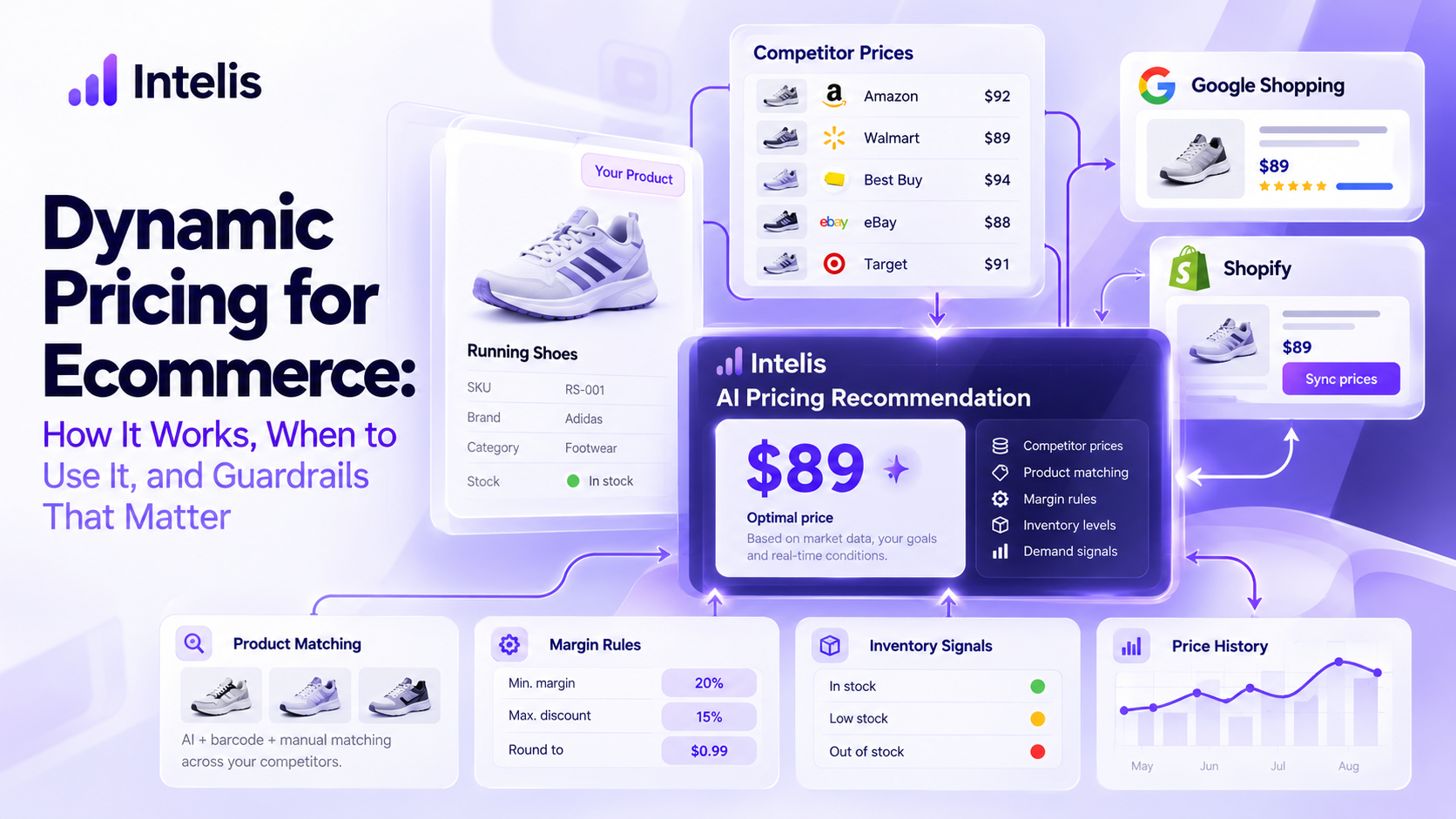
Dynamic Pricing for Ecommerce: How It Works, Signals & Guardrails
Updated: 2 days ago
Quick answer
Dynamic pricing for ecommerce adjusts product prices using changing market and business signals while applying rules for margin, product context, market and channel. It is broader than simply copying the lowest competitor price.

Ecommerce dynamic pricing is a strategy that automatically adjusts product prices in real-time based on factors like market demand, competitor pricing, and customer behavior. This pricing approach helps businesses remain flexible and competitive by continuously optimizing prices to reflect market conditions.
What does dynamic pricing mean in ecommerce?
First of all, what is dynamic pricing? Dynamic pricing adjusts prices for products and services using external data points, such as competitor pricing, customer behavior, product demand, and inventory levels. In ecommerce, dynamic pricing relies on automation, with tools gathering data in real time — like competitor price changes or demand fluctuations — and adjusting prices accordingly.
Why dynamic pricing matters
Maximize profitsEcommerce dynamic pricing ensures that you set the optimal price at any given time. When demand surges, prices can increase to maximize profit. During slower periods, prices can be lowered to attract customers. This adaptability helps you continuously optimize your profit margins.
Stay competitive in the marketIn ecommerce, price competition is constant. Dynamic pricing allows you to react quickly to price changes by competitors. If your competitors lower their prices, a dynamic pricing system can adjust your prices accordingly, ensuring you remain competitive without sacrificing margins.
Customer segmentation and personalized pricingDynamic pricing also enables personalized pricing for different customer segments. You can offer tailored pricing based on factors like browsing behavior or purchase history, enhancing the customer experience and encouraging repeat business.
Key factors influencing ecommerce dynamic pricing
Several factors influence ecommerce dynamic pricing:
Market demandPricing adjusts based on demand. When demand increases, prices can rise to capitalize on interest. When demand slows, prices decrease to boost sales. Dynamic pricing ensures you’re always responding to market trends.
Competitor pricingCompetitor pricing is a key factor in dynamic pricing. Best-in-class pricing tools monitor competitors' prices in real time, adjusting your prices to stay competitive.
Inventory levelsPricing can also reflect inventory levels. When stock is low, prices can increase to manage demand and preserve inventory. Conversely, when stock is high, prices may decrease to sell excess inventory faster.
How to implement ecommerce dynamic pricing
Dynamic pricing requires the right tools and thoughtful implementation.
Use dynamic pricing toolsAutomation is key to effective dynamic pricing. Dynamic pricing software collects data from various sources, such as competitor prices, market trends, and customer behavior, to make real-time pricing decisions. These tools can integrate with your ecommerce platform, automating price adjustments across your store.
Set pricing rules and thresholdsWhile dynamic pricing tools automate adjustments, you must set clear rules and thresholds. Define minimum and maximum price limits to protect your profit margins. Setting boundaries ensures your pricing strategy remains balanced and profitable.
Monitor and adjust as neededAlthough dynamic pricing is automated, continuous monitoring is essential. Track sales performance, customer feedback, and competitor actions, and make adjustments when necessary. Regular review of data will help you fine-tune your strategy over time.
Benefits and challenges of ecommerce dynamic pricing
Dynamic pricing offers clear benefits, but it also has challenges:
BenefitsDynamic pricing increases profitability by allowing you to adjust prices based on real-time conditions. You can capture more sales during high-demand periods and avoid price stagnation when demand is low. Automated tools also save time by eliminating manual price updates.
Personalized pricing for different customer segments is another benefit. This approach can improve customer satisfaction and drive repeat purchases.
ChallengesFrequent price fluctuations can frustrate customers. If they notice significant price differences over a short period, it could lead to distrust. It’s important to strike a balance between flexibility and consistency to avoid alienating your customers. Setting price thresholds can help minimize this issue.
Another challenge is pricing wars. If you adjust prices too aggressively, competitors may follow suit, leading to a race to the bottom where profits suffer. Careful monitoring of competitor behavior and setting strategic pricing rules will help you avoid this problem.
Ecommerce dynamic pricing TL;DR
Ecommerce dynamic pricing is a powerful strategy that enables businesses to stay competitive in a fast-moving market. By using real-time data to adjust prices, companies can maximize profits, respond to market shifts, and provide personalized shopping experiences. While dynamic pricing requires the right tools and thoughtful implementation, the benefits — increased sales and improved customer satisfaction — make it a worthwhile investment.
Start implementing dynamic pricing today to stay ahead in the ecommerce game and capture more sales.
A practical ecommerce dynamic pricing framework
For ecommerce, dynamic pricing is most effective when it connects market intelligence with the operational systems that actually publish product prices. The workflow has to account for catalog scale, product variants, Google Shopping or marketplace visibility, storefront pricing, and multi-market rules.
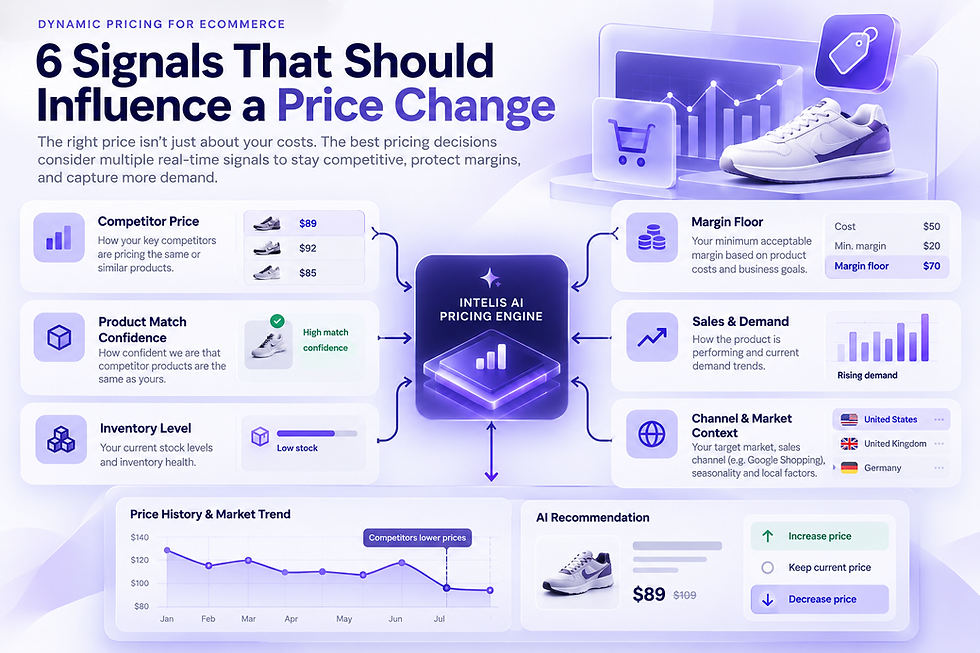
Six signals that should influence an ecommerce price change
Competitor price and position.
Product-match confidence.
Margin floor and product economics.
Sales, traffic or demand signals.
Inventory level and availability.
Channel and market context, including country, currency and seasonal conditions.
Why product matching comes before repricing
If the competitor product is not truly equivalent, the competitor price is the wrong input. Matching should account for identifiers, variants, pack sizes, brand and other attributes before the pricing engine treats an offer as comparable.
Dynamic pricing and Google Shopping
Google Shopping adds another operational requirement: the price shown in the feed and the price shown on the landing page need to remain accurate. Merchant Center can use automatic updates for price and availability to correct some mismatches, but Google states that automatic updates are not a replacement for regularly maintained product data.
Dynamic pricing across Shopify Markets
International ecommerce pricing should not assume one price works everywhere. Shopify Markets supports pricing and currency customizations by market, which makes market-level pricing rules more practical for global stores.
When to automate and when to require approval
Low-risk catalog changes can often be automated when the data and guardrails are strong. High-impact SKUs, sensitive brands, unusual competitor moves or large price changes may deserve human approval.
Frequently asked questions
What is dynamic pricing for ecommerce?
It is the use of changing market and business signals to adjust ecommerce product prices within defined rules and guardrails.
Is dynamic pricing the same as price matching?
No. Price matching usually follows a specific competitor price. Dynamic pricing can incorporate competitors alongside margin, inventory, demand, history and market context.
Can ecommerce dynamic pricing be automated?
Yes, but the level of automation should reflect the quality of the data and the commercial risk. Many teams combine automated recommendations with rule-based approvals.


