Repricing vs. Dynamic Pricing: What's the Difference?
Repricing and dynamic pricing are often used interchangeably, but they are not exactly the same thing. Both involve changing product prices, yet they differ in how broadly they use data and how the pricing decision is made.
The simplest way to think about it: repricing focuses on changing a listed price, often in response to competitors or rules; dynamic pricing is the broader decision framework that can combine competitors with demand, inventory, costs, seasonality and other business signals.
Repricing: a narrower execution problem
A repricer is typically designed to update prices according to a defined rule. For example: stay $1 below a competitor, match the lowest relevant offer, or raise the price when competitors move upward.
That can be extremely useful in fast-moving ecommerce environments because it reduces manual work and keeps listed prices aligned with a chosen rule.
Dynamic pricing: a broader decision problem
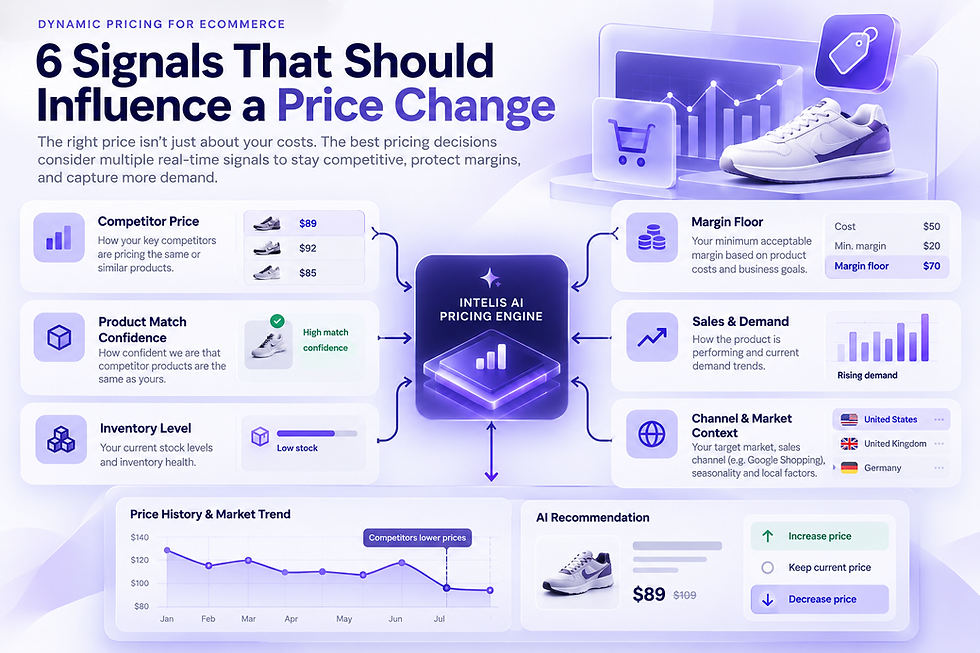
Dynamic pricing asks a larger question: given the current market and business context, should the price increase, decrease or stay unchanged?
Competitor prices can still be an important input, but they sit alongside other signals such as margin, inventory, demand, sales history, market, seasonality and product strategy.
Repricing vs. dynamic pricing at a glance
Primary focus — Repricing: update a listed price. Dynamic pricing: choose the right price given multiple signals.
Typical inputs — Repricing: competitor prices and rules. Dynamic pricing: competitors plus demand, inventory, margin, seasonality, performance and market context.
Common use case — Repricing: fast competitive response. Dynamic pricing: broader pricing optimization.
Guardrails — Both should use minimum margin, competitor filters and price-change limits.
Automation — Both can be manual, approval-based or fully automated depending on risk.
Example: competitor-driven repricing
A merchant wants to remain within 2% of the median price of three approved competitors. When those competitors change price, the repricer recalculates the target and updates the merchant's offer within the allowed margin floor.
Example: dynamic pricing
The same merchant sees competitors reduce price, but inventory is already low and demand remains strong. Instead of following the market downward, the dynamic-pricing logic recommends holding the current price because the broader business context does not justify a reduction.
When repricing is enough
Repricing can be enough when the objective is clear, competitor data is reliable, and the pricing decision genuinely depends on a small set of rules.
It is especially useful for straightforward competitive-position strategies where speed matters more than a complex optimization model.
When dynamic pricing is more appropriate
Dynamic pricing becomes more valuable when products have different margins, inventory positions, demand patterns or market strategies, or when the business sells across multiple countries and channels.
Can the two approaches work together?
Yes. Repricing can be the execution layer inside a broader dynamic-pricing strategy. The dynamic logic determines the acceptable target or range, while the repricer applies the approved change to the relevant channel.
For Google Shopping and ecommerce feeds, execution also needs to keep storefront and feed prices synchronized. Google Merchant Center supports automatic product-information updates for price and availability, but Google notes these corrections are not a replacement for maintaining accurate product data.
Which one should you choose?
Choose the simplest approach that can represent the decision you actually need to make. If competitor-relative rules are enough, repricing may be sufficient. If prices should reflect multiple business signals, dynamic pricing provides a broader framework.
Frequently asked questions
Is repricing the same as dynamic pricing?
No. Repricing is the act or workflow of changing a listed price, while dynamic pricing is a broader strategy that can use multiple signals to decide what the price should be.
Can dynamic pricing include repricing rules?
Yes. Competitor-relative repricing rules can be one component of a larger dynamic-pricing system.
Which is better for ecommerce?
It depends on the use case. Simple competitive catalogs may need only controlled repricing, while larger or more complex catalogs often benefit from demand, inventory, margin and market context as additional inputs.