
Dynamic Pricing for Retail: Strategy, Examples and Guardrails
Dynamic pricing for retail is the controlled adjustment of product prices using changing market and business signals. The objective is not to change every price constantly. It is to make better price decisions at the right cadence while protecting margin, brand rules, and customer trust.
For retailers managing hundreds or thousands of SKUs, the challenge is scale: competitor prices move, demand changes, inventory ages, promotions begin and end, and different markets can require different pricing logic.
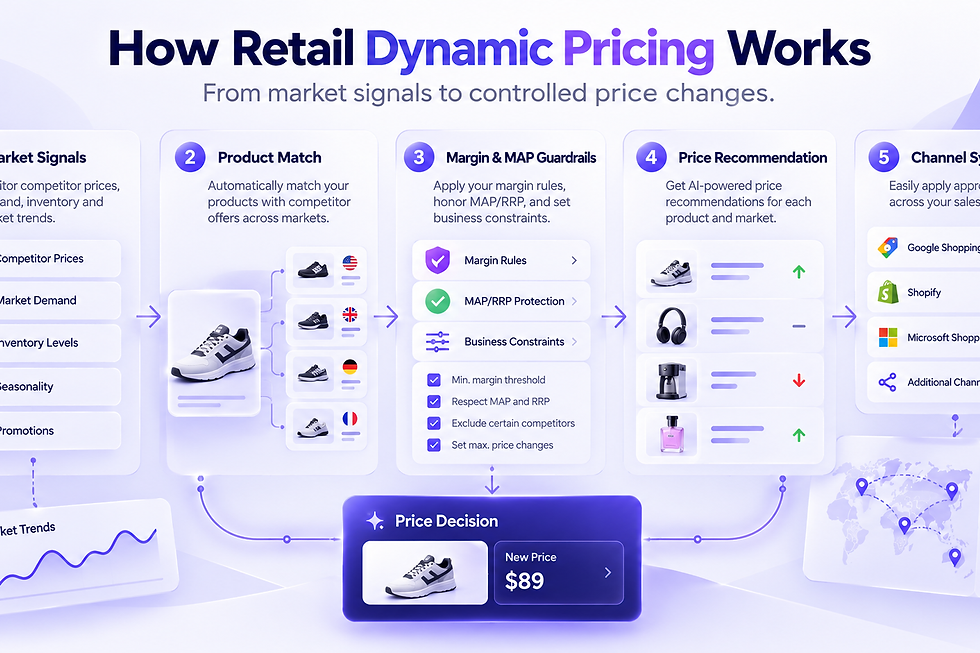
How dynamic pricing works in retail
A retail dynamic-pricing workflow typically combines four layers: market signals, accurate product context, business constraints, and execution.
Market signals: competitor prices, demand, seasonality, promotions and inventory.
Product context: correct product and variant matching across competitors and markets.
Guardrails: margin floors, maximum price changes, MAP/RRP rules, category rules and excluded competitors.
Execution: recommendations, approvals or automated price updates to the channels where the retailer sells.
Retail dynamic pricing is not just competitor matching
Matching a competitor price can be useful, but it is only one possible rule. A retailer may intentionally stay above a competitor because of stronger service, faster delivery, higher brand value or lower inventory. The right retail pricing strategy needs to reflect the retailer's own economics.
Six signals retailers should consider before changing a price
Competitor position: Are you above, below or inside the relevant market range?
Margin: Can the proposed change stay above your minimum acceptable margin?
Inventory: Is stock high, low, aging or at risk of selling out?
Demand: Are sales, traffic or conversion moving meaningfully?
Seasonality: Is the product approaching a seasonal peak or decline?
Market context: Should the same SKU have different pricing logic by country, channel or customer segment?
Retail dynamic pricing examples
Example 1: Increase price when the market moves up
If several relevant competitors increase prices while your product remains well below the market, a retailer may have room to raise price without sacrificing competitiveness.
Example 2: Protect margin during a price war
If one competitor cuts price aggressively, a margin floor can prevent an automated rule from following the move below a profitable threshold.
Example 3: Use inventory as a pricing signal
High inventory can justify more aggressive pricing or promotions, while scarce inventory may support a higher price if demand remains strong.
Example 4: Use different pricing by market
International retailers should treat each market as its own context. Shopify Markets, for example, supports market-specific currencies and pricing customizations rather than forcing one global customer price.
Guardrails that make retail automation safer
Minimum margin or contribution threshold.
Maximum daily or weekly price change.
MAP/RRP or brand-policy constraints where applicable.
Competitors or sellers that should not drive repricing.
Different rules by category, brand, market or channel.
Approval requirements for high-impact changes.
Audit history explaining why a recommendation was made.
Dynamic pricing across Google Shopping and retail channels
When prices change, channel consistency matters. Google Merchant Center supports automatic updates to price and availability based on landing-page data, but those automations are intended to correct mismatches rather than replace reliable product-feed management.
A retail pricing workflow should therefore treat price execution as an operational process: approve the decision, update the source of truth, synchronize the storefront and feeds, and then monitor the outcome.
When retailers should not fully automate
Some products deserve tighter control: premium launches, highly regulated categories, strategic hero products, sensitive reseller relationships, or products where a single price change has disproportionate commercial impact. In those cases, recommendations plus human approval may be better than full automation.
Dynamic pricing for retail: a practical framework
The strongest retail systems do not optimize for 'lowest price.' They optimize for the retailer's objective within clear constraints. That might mean defending market position, protecting margin, clearing inventory, supporting a promotion, or maintaining a premium brand position.
Frequently asked questions
What is dynamic pricing in retail?
It is the use of changing market and business signals to adjust retail prices according to predefined objectives and guardrails.
Do retail prices need to change in real time?
No. The right cadence depends on category volatility, business needs and operational risk. Some retailers update daily or weekly rather than continuously.
What is the biggest risk of retail dynamic pricing?
Poor data or weak guardrails can cause unnecessary price changes, margin erosion or inconsistent channel pricing. Reliable matching, constraints and monitoring are essential.

