Ecommerce Competitor Monitoring: What to Track and How to Act
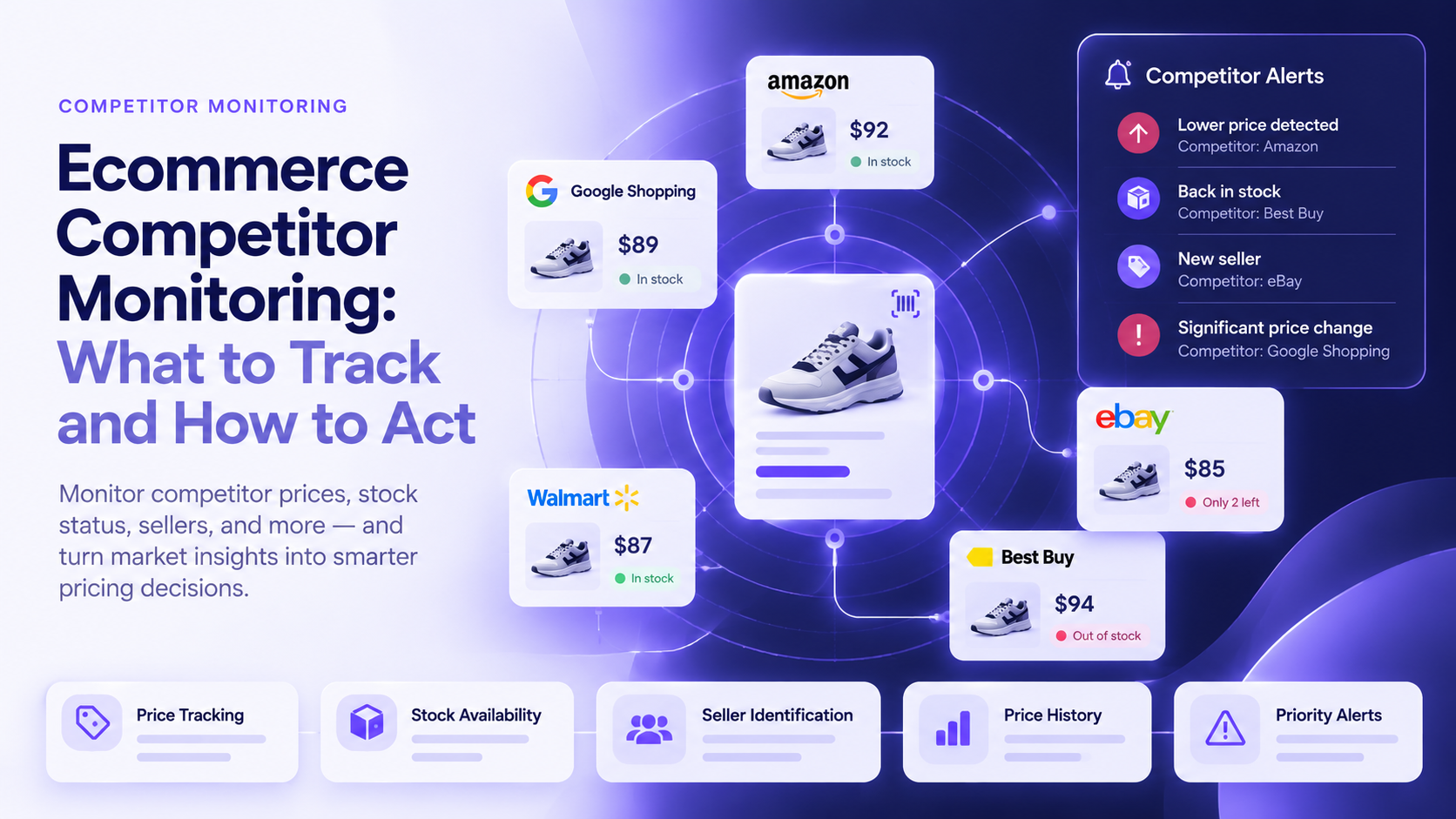
Ecommerce competitor monitoring is the continuous process of tracking the market signals that can change how you price, position, and promote a product. Price is the obvious signal, but useful monitoring also covers product matches, availability, sellers, marketplaces, promotions, and how those signals change over time.
The goal is not to react to every competitor move. It is to build enough context to know which market changes matter, which should be ignored, and when a pricing decision is actually justified.
What should ecommerce competitor monitoring track?
A strong monitoring workflow starts with a small set of signals that directly affect commercial decisions.
Competitor price: the current advertised price for the same or intentionally comparable product.
Product match confidence: whether the competitor listing is truly the same SKU, variant, pack size, or model.
Availability: whether the competing offer is actually in stock and purchasable.
Seller identity: whether the offer comes from an authorized reseller, marketplace seller, direct retailer, or another source.
Promotion context: coupons, bundles, sale prices, shipping, and other factors that can make a headline price misleading.
Price history: how long a price has been in place and whether it is a temporary move or part of a wider trend.
Market and channel: country, currency, marketplace, Google Shopping, retailer site, or other channel where the price appears.
Why price alone is not enough
A competitor price can look actionable and still be the wrong benchmark. A lower offer may be out of stock, tied to a different variant, sold by an unauthorized seller, or available only in another market. Repricing against bad context can create unnecessary margin loss.
Product Matching in Ecommerce explains why accurate matching has to come before price comparison.
A practical competitor-monitoring workflow
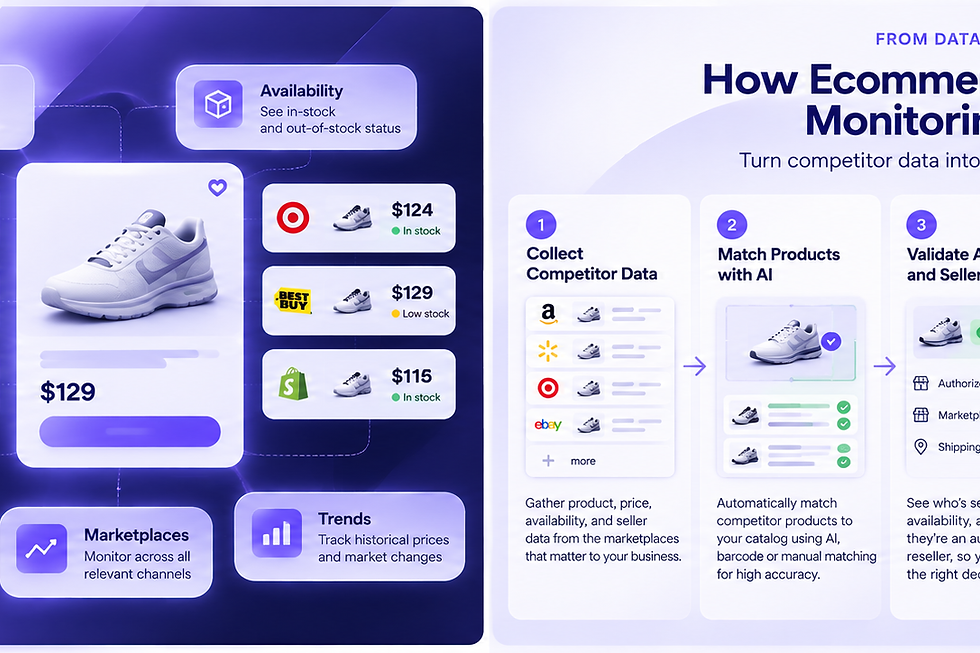
1. Collect market data
Gather prices, availability, seller and channel information for the competitors that matter to your business. More data is not automatically better; relevance matters more than raw volume.
2. Match products correctly
Use reliable identifiers such as GTIN, UPC, EAN, MPN, brand and variant attributes where available. AI or semantic matching can help when retailer titles and descriptions do not line up cleanly.
3. Validate the offer
Check whether the offer is live, in stock, relevant to the same market, and sold in a context you actually want to use as a benchmark.
4. Compare against history
A single low price is different from a sustained market shift. Historical context helps teams distinguish noise from a real competitive trend.
5. Prioritize the action
The right response may be to decrease price, increase price, hold the current price, investigate a seller, or do nothing. Monitoring should make decisions more selective, not more reactive.
How competitor monitoring supports dynamic pricing
Competitor data becomes most useful when it is one input into a controlled pricing workflow. A price engine can combine market position with margin floors, MAP or RRP constraints, inventory, sales performance, seasonality, and business rules before recommending a change.
Competitor monitoring across Google Shopping and ecommerce channels
Google Shopping is especially useful for competitive visibility because shoppers can see comparable products and prices side by side. For merchants, however, feed accuracy matters just as much as competitive position. Google Merchant Center can automatically update attributes such as price and availability from landing-page data when its automations are enabled, but Google explicitly notes that these updates are not a replacement for regularly maintained product data.
For Shopify merchants selling internationally, market context also matters. Shopify Markets supports market-specific currencies and pricing customizations, so a competitor price in one region should not automatically dictate the right price in another.
Common competitor-monitoring mistakes
Repricing against the cheapest offer without validating the product match.
Treating an out-of-stock competitor as a meaningful price benchmark.
Mixing countries, currencies, taxes, or shipping contexts.
Ignoring seller quality or authorization.
Reacting to one-off promotions as if they were permanent market prices.
Monitoring hundreds of competitors when only a handful influence customer decisions.
Automating price changes without margin or policy guardrails.
How often should competitor prices be monitored?
The right frequency depends on how quickly your market moves. A fast-moving consumer-electronics category may justify daily monitoring, while a stable B2B catalog might need a less frequent cadence. What matters is that monitoring frequency matches the speed of meaningful market change.
From monitoring to action
The value of competitor monitoring is not the dashboard itself. It is the ability to turn reliable market observations into better decisions. For ecommerce teams managing large catalogs, that means filtering noise, identifying the products that actually need attention, and applying changes with clear guardrails.
Frequently asked questions
What is ecommerce competitor monitoring?
It is the ongoing tracking of competitor prices, availability, sellers, products, promotions and market changes so ecommerce teams can make better pricing and merchandising decisions.
What is the difference between competitor monitoring and price monitoring?
Price monitoring focuses primarily on price. Competitor monitoring is broader and includes the context needed to understand whether a price observation is actually relevant.
Should I automatically match the lowest competitor price?
Usually not. The lowest price may be irrelevant because of stock, seller, variant, market or margin differences. Automated repricing should use business rules and guardrails rather than blindly chasing the cheapest offer.


