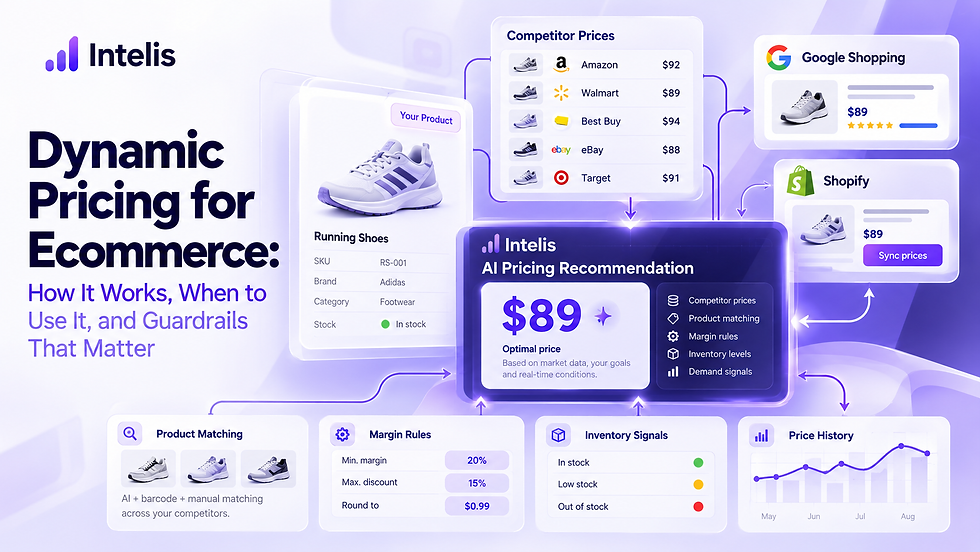
How to Implement Dynamic Pricing: A Step-by-Step Guide
Updated: 2 days ago
Quick answer
Dynamic pricing implementation starts with the business objective, not the algorithm. Define what the pricing system is allowed to optimize, choose the right signals, validate product data, set guardrails, decide what can be automated, and measure outcomes after prices change.

Dynamic pricing isn’t about constantly changing prices — it’s about changing them strategically.
For ecommerce brands, the goal isn’t to race to the bottom. It’s to respond to real-time signals, protect your margins, and stay one step ahead of competitors. When done right, dynamic pricing helps you maximize profitability and visibility without compromising brand value.
Here’s how to set up dynamic pricing in a way that actually delivers results.
Understand what dynamic pricing is
At its core, dynamic pricing is a strategy that automatically adjusts product prices based on changing market data. That might include competitor pricing, product demand, stock levels, or campaign performance.
This isn’t the same as running flash sales or discounts. A true dynamic pricing setup is rule-based, data-informed, and designed to help you price with intent — not guesswork.
In channels like Google Shopping, where price often dictates who gets the click, having a dynamic strategy in place can make or break your campaign performance.
Define your pricing objectives
Before jumping into automation, you need a clear sense of what you want to achieve.
Are you looking to maximize profit margins? Win more impressions on Google Shopping? Clear inventory before a seasonal reset? Your pricing objectives should map directly to your business goals.
This is where some brands go wrong. They automate prices without a strategy — and end up chasing short-term wins at the expense of long-term value. A smarter approach is to define your goals, then build pricing rules that reinforce them.
Set guardrails to protect your brand
One of the biggest risks with automation is going too low — or too high — without meaning to. That’s why pricing guardrails are essential.
Define minimum and maximum thresholds for every product or category. This ensures your dynamic pricing tool never drops prices below your profit floor or exceeds what customers are willing to pay.
For brands that enforce a minimum advertised price, guardrails also help with MAP compliance. If MAP violations are a concern, you can learn more about MAP monitoring for Google Shopping and how to track unauthorized discounting at scale.
Choose the right data inputs
Dynamic pricing is only as smart as the signals it uses. The best pricing engines combine multiple sources of data to make decisions that align with your strategy.
Some of the most valuable inputs include:
Competitor pricing across channels
Real-time inventory levels (yours and your competitors’)
Conversion rates and click-through performance
Seasonal trends and sales velocity
Cost of goods and margin targets
Tools like Intelis’ dynamic pricing software take these inputs into account automatically, helping you respond to market changes the moment they happen — not days later.
Build your pricing rules
Once your data is flowing, it’s time to define how your pricing engine should behave.
You don’t need to overcomplicate it. Start with a few simple rules, like:
Match the lowest rated competitor — but never drop below your margin
Stay within 5% of the market average
Undercut the top competitor on key SKUs during peak periods
Your rules should align with your brand position. If you’re a value brand, staying aggressively competitive might make sense. If you’re a premium brand, your rules might focus more on price integrity while reacting only in strategic moments.
Implement a dynamic pricing tool
Doing this manually won’t scale. Dynamic pricing requires speed, precision, and real-time updates — which means automation isn’t optional.
Look for a tool that connects directly to your ecommerce platform and ad channels. You’ll want something that can push price changes in real time, reflect inventory shifts, and give you clear visibility into what’s changing and why.
Monitor, test, and optimize
Dynamic pricing isn’t set-it-and-forget-it. Once your rules are live, it’s critical to monitor how your pricing strategy performs.
Are you seeing better conversion rates? Are margins holding steady? Is visibility improving in paid shopping channels?
You can adjust your strategy based on weekly trends and competitive shifts. The best results come from iterating — not guessing.
Final thoughts on dynamic pricing
Setting up dynamic pricing isn’t about chasing every competitor move or racing to the bottom. It’s about building a pricing system that reflects your goals, adapts in real time, and reinforces your value.
When done right, dynamic pricing gives you an edge — not just in profitability, but in operational confidence. You’ll be able to respond faster, price smarter, and win more consistently across every channel.
If you're ready to make that happen, check out Intelis’ dynamic pricing software. It’s built to help merchants like you price with speed, strategy, and complete control.
Dynamic pricing implementation checklist
Define the objective: margin protection, competitiveness, inventory clearance, growth, market positioning or another measurable goal.
Choose the inputs: competitor prices, demand, sales, inventory, seasonality, costs and market context.
Validate product matching so competitor data is attached to the right SKU and variant.
Set hard guardrails such as margin floors, maximum price movements, MAP/RRP rules where applicable and competitor exclusions.
Create pricing logic by category, brand, market or product importance instead of forcing one rule across the entire catalog.
Decide the approval model: recommendation only, approval required, auto-approval for low-risk changes or full automation.
Synchronize approved prices with the storefront, feeds and downstream channels.
Monitor outcomes and refine the rules using sales, conversion, margin and competitive position.
Related Intelis guides
Frequently asked questions
How do you start dynamic pricing?
Start by defining the commercial objective and the rules the system must never violate. Only then decide which data inputs and pricing logic are needed.
How long does dynamic pricing implementation take?
It depends on catalog complexity, integrations, data quality and the level of automation. A controlled pilot on a subset of products is usually safer than switching an entire catalog at once.
What products should be included in a pilot?
Choose products with reliable data and meaningful competitive activity, but avoid starting with the most sensitive or highest-risk SKUs.