
Retail Dynamic Pricing Examples: 7 Practical Scenarios
Retail dynamic pricing becomes easier to understand when you look at the decisions it supports in real situations. The goal is not to change prices simply because software can. The goal is to use changing market and business signals to make a better decision than a static price would allow.
Below are seven practical retail scenarios that show where dynamic pricing can help — and the guardrail that keeps each scenario under control.
1. Competitors raise prices and you have room to increase
Imagine several relevant competitors move a product from roughly $99 to $109 while your price remains at $95. If demand is stable and your offer remains attractive, holding at $95 may leave unnecessary margin on the table.
A dynamic-pricing rule can flag the opportunity to move upward while keeping your price inside the competitive range rather than automatically jumping to the highest market price.
Guardrail
Limit the maximum price increase and require the system to compare against multiple relevant competitors rather than a single outlier.
2. One competitor starts a price war
A major competitor suddenly cuts a product by 20%. Blindly matching that price can destroy margin, especially if the promotion is temporary.
A better workflow checks whether the lower price is persistent, whether the competitor is in stock, and whether matching it would violate your minimum margin.
Guardrail
Use a margin floor plus a competitor filter so one aggressive seller cannot drag your entire category downward.
3. Inventory is too high
A retailer enters the final weeks of a season with excess inventory. Competitor prices are stable, but holding the current price risks carrying stock into the next cycle.
Inventory can become a pricing signal: products with unusually high stock or weak sell-through can receive a more aggressive price recommendation than products with healthy inventory.
Guardrail
Use inventory thresholds and a maximum markdown rule instead of applying the same discount to the entire category.
4. Inventory is scarce while demand remains strong
The opposite case also matters. If a product is selling quickly and stock is limited, the retailer may not need to remain the lowest-priced seller.
A pricing system can recommend holding or increasing price when inventory is scarce and demand is strong, provided the new price still fits the retailer's market-positioning strategy.
Guardrail
Set a ceiling or approval threshold for large increases so scarcity does not create uncontrolled price jumps.
5. A seasonal peak changes willingness to pay
Products tied to holidays, weather or annual events can have very different demand profiles throughout the year. A static price ignores those predictable changes.
Retailers can plan seasonal rules in advance and then use live market data to decide how aggressively to adjust within those periods.
Seasonal Pricing for Retail goes deeper into how to structure those seasonal rules.
6. The same SKU behaves differently by market
A product that is highly competitive in Germany may have very different demand and competitor coverage in the UK or United States. One global rule can therefore create weak local decisions.
Market-specific pricing logic lets retailers evaluate local competitors, currency, assortment and business goals separately.
7. A promotion needs tighter coordination
During a planned promotion, a retailer may want to stay within a target market position without allowing automation to erase the intended promotional margin.
Dynamic pricing can still operate during the campaign, but the promotional price range becomes an additional constraint.
What these examples have in common
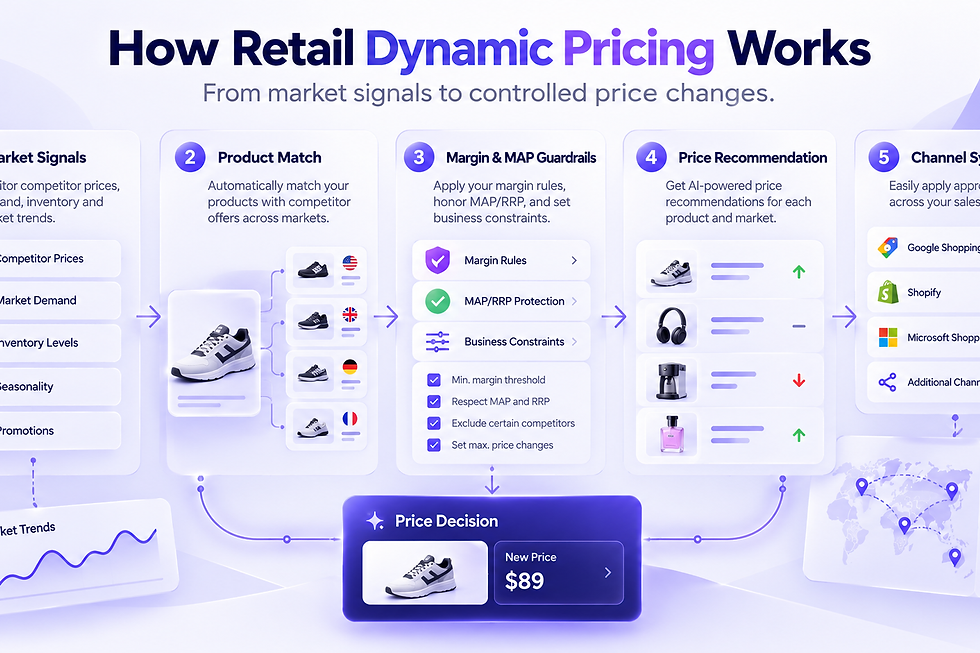
Each scenario uses a different signal, but the underlying structure is the same: collect relevant data, validate the context, apply business constraints, recommend a price, and measure the result.
Competitor movement should be validated before it drives a response.
Inventory can influence both markdown and markup decisions.
Seasonality should be planned, not treated as random volatility.
Different markets can require different pricing logic.
Margin and price-change limits should remain active even during automation.
Frequently asked questions
What is an example of dynamic pricing in retail?
One example is raising or lowering a product's price when competitor prices, demand or inventory change, while keeping the recommendation inside predefined margin and price-change rules.
Does dynamic pricing always mean lowering prices?
No. It can recommend an increase, decrease or no change at all depending on the objective and the market context.
Which retail products work best for dynamic pricing?
It is most useful where prices, demand, inventory or competitive conditions change often enough that static pricing leaves meaningful opportunities or risks.

