Pricing Engine for Ecommerce Catalog Optimization: How to Scale Price Decisions
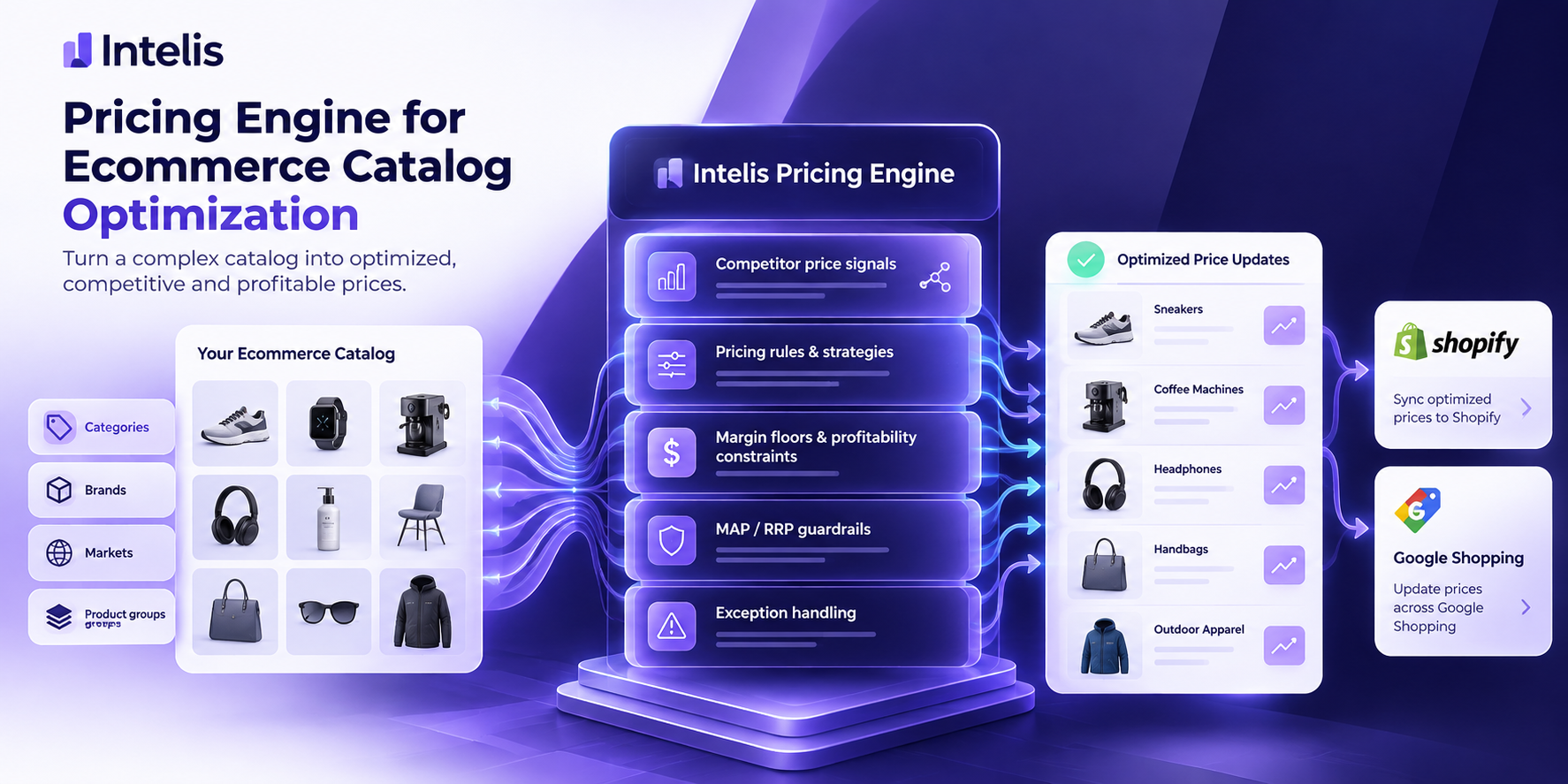
A pricing engine for ecommerce catalog optimization is not just a formula that changes one price at a time. It is the decision layer that turns market signals, costs, rules and exceptions into consistent pricing actions across a catalog that may contain hundreds, thousands or tens of thousands of SKUs.
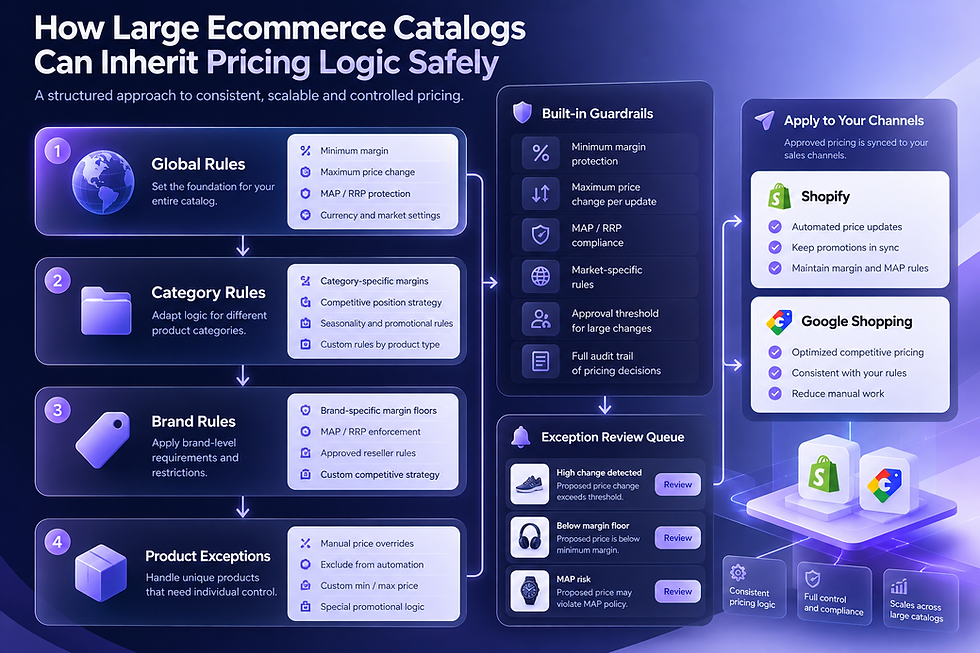
The core challenge is scale without chaos. As the catalog grows, manually maintaining product-level rules becomes fragile. The better architecture is hierarchical: global logic sets the baseline, categories and brands inherit that logic, and only the products that truly need special treatment become exceptions.

What a pricing engine actually does
A pricing engine combines several jobs that are often scattered across spreadsheets, competitor-monitoring tools and ecommerce admin screens. It decides which inputs are trustworthy, which rule applies to each SKU, whether the proposed price is allowed, and where an approved price should be published.
Group products into segments that can share pricing logic.
Combine competitor, market, cost, margin and performance signals.
Apply global, category, brand and product-level rules in a predictable order.
Enforce floors, ceilings, MAP/RRP constraints and maximum-change limits.
Route unusual or high-impact changes to an exception queue.
Write approved prices back to the storefront or channel.
Preserve the reasoning and history behind each decision.
Why catalog optimization needs hierarchy
A large catalog usually contains several pricing behaviors at once. Commodity products may need aggressive competitive positioning. Premium brands may need tighter MAP or margin controls. Long-tail products may have sparse competitor data. New products may need a waiting period before automation begins.
If every SKU is configured independently, the pricing system becomes difficult to maintain. Hierarchical rules let the catalog inherit sensible defaults while still allowing local exceptions.
Level 1: global rules
Global rules define the non-negotiable baseline: minimum margin, maximum price change, supported markets, default approval thresholds and what the system should do when no valid competitor data exists.
Level 2: category rules
Categories often have different economics and competitive behavior. A consumer-electronics category may require frequent updates, while a premium accessories category may prioritize margin stability and brand positioning.
Level 3: brand rules
Brand-level rules are useful for MAP/RRP requirements, preferred competitive positions, approved reseller sets or internal restrictions that should apply consistently across that brand's assortment.
Level 4: product exceptions
Exceptions should be reserved for products that genuinely differ from the inherited strategy. Examples include clearance inventory, hero products, newly launched SKUs, bundles, limited stock or products that need manual approval.
The inputs a pricing engine should normalize
Before the engine calculates a recommendation, its inputs need to be comparable. A competitor observation is only useful when the system knows that it is the same product or a deliberately chosen comparable item, in the correct market, with current availability and a recent timestamp.
If matching quality is the weak link, our product matching software guide covers identifiers, variants, bundles, confidence and review workflows in more detail.
Guardrails matter more as automation scales
A mistake on one manually edited SKU is inconvenient. The same mistake applied automatically across a large product group is expensive. Catalog-scale pricing therefore needs explicit safety rules before any recommendation is allowed to become a live price.
Minimum margin or minimum allowed price.
Maximum increase or decrease per update.
MAP, RRP or brand-policy constraints.
Approval thresholds for unusually large changes.
Competitor-quality and freshness requirements.
Rules for out-of-stock or missing competitors.
Market-specific currency and pricing logic.
An audit trail for manual overrides and automated decisions.
Google's automated-discounts system illustrates the same design principle at a different layer: merchants define minimum prices, cost information and product groups before Google optimizes eligible discounted prices. It is a separate Google feature, not an Intelis workflow, but it shows why pricing automation needs product scope and hard limits.
How prices should be executed at catalog scale
The decision engine and the execution layer should be separate. The engine calculates an approved price; the execution layer updates the ecommerce platform and any connected product-data workflow.
For Shopify, the Admin GraphQL API provides bulk product-variant update operations that can be used as part of large-scale catalog operations. The important architectural point is to batch and validate approved updates rather than issuing uncontrolled one-off writes.
If those products are advertised on Google Shopping, Google requires the submitted price to match the landing page and checkout. That makes channel synchronization part of the pricing workflow, not an afterthought.
What to measure after the engine goes live
Catalog optimization should be measured by more than the number of automated price changes. Review whether the engine is making commercially useful decisions and whether exceptions are shrinking or growing.
Share of SKUs with reliable competitive data.
Share of recommendations applied automatically versus reviewed manually.
Products repeatedly hitting margin or MAP constraints.
Frequency of manual overrides.
Price-change volume by category, brand and market.
Revenue, margin and conversion outcomes where those signals are available.
Products with stale, missing or ambiguous competitor data.
Where Intelis fits
The current Intelis dynamic pricing platform combines Google Shopping competitor monitoring, dynamic price updates, MAP monitoring and historical competitor trends. Intelis also positions the platform for high-SKU businesses that need to select and synchronize large product sets rather than manage pricing SKU by SKU.
For an ecommerce team, the practical goal is not maximum automation. It is a pricing engine that applies the same business logic consistently across the catalog while making the important exceptions visible.
Sources and further reading
Google Merchant Center: Add products to automated discounts
Shopify Admin API: productVariantsBulkUpdate
Google Merchant Center: Price attribute requirements


