
Multi-Market Ecommerce Pricing: A Practical Strategy for Retailers
A single global price rarely tells the whole story. A retailer selling in several countries may face different local competitors, shipping costs, taxes, exchange rates, inventory constraints and customer expectations. Multi-market pricing turns these differences into a controlled decision process—not an excuse to change prices at random.
Quick answer
Multi-market ecommerce pricing means choosing and managing prices separately for defined countries, regions or storefront markets. The goal is to remain locally competitive while protecting the contribution margin, consistency and positioning of each market. A good process starts with comparable local competitor offers, calculates local economics, sets guardrails and monitors the results.
Why one price does not fit every market
Two shoppers can view the same product but face very different offers. A competitor may only ship to one destination, include a promotion in one region, or show different delivery terms. Even when list prices appear comparable, landed cost and profitability can differ substantially. Using a single global competitor benchmark can hide these differences.
Competitor landscape: the relevant sellers and substitute products vary by region.
Currency and exchange rates: conversion creates volatility and can change how rounded prices look.
Local economics: shipping, payment fees, returns and import-related costs can change unit contribution.
Availability: a low offer from an out-of-stock seller should not automatically drive a response.
Brand positioning: local promotions, MAP policies where applicable, and perceived price tiers may differ.
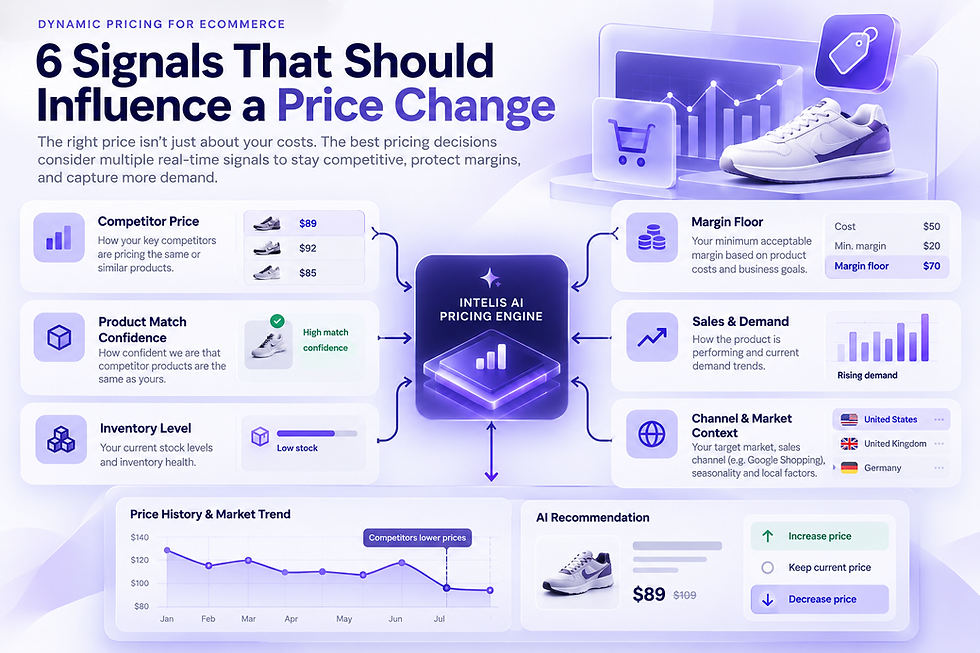
The six signals to capture per market
A pricing dashboard is most useful when each product-market pair has a clear record. Do not aggregate everything into a single “competitor price” field.
A verified product match (barcode, model identifier or reviewed attribute-level match).
The current relevant advertised competitor price and any visible promotion.
Competitor availability, merchant identity, destination and shipping context.
Your locally effective selling price in the shopper’s currency.
Local contribution economics: unit cost plus relevant market-specific expenses.
A history of meaningful price movements, and the date the observation was refreshed.
A practical five-step multi-market pricing workflow
1. Define the market before collecting prices
Make “market” an operationally useful unit. That might be a country storefront, a delivery destination, or a distinct currency-and-catalog combination. Record which products are sold and which competitors genuinely serve shoppers there. A seller appearing on an international search page is not necessarily a comparable local offer.
2. Match products before comparing offers
Confirm that a competitor result refers to the same item, size, pack quantity and condition. Automated matching can prioritize candidates, but uncertain matches need review. Mistaking a bundle for a single unit can make an attractive-looking price gap meaningless.
3. Normalize economics, not just currencies
Convert competitor prices for analysis when helpful, but keep the customer-facing local price distinct. Compare like-for-like offers and calculate your price floor using market-specific economics. For example, a 10% nominal price advantage can evaporate once higher delivery and return expenses are considered. That is an illustration, not a benchmark or promised margin outcome.
4. Set rules and approval thresholds
Define a minimum contribution margin, maximum permitted change, response delay, and exception path for low-confidence matches. Market-specific rules are usually safer than copying one competitor’s newest price everywhere. Use a human approval step when the price move is large, data confidence is low, or the item is strategically sensitive.
5. Monitor outcomes by product and market
Review price gaps, competitor coverage, stale observations, margin impact and conversion or sales patterns separately for each market. Assess results over a suitable time window; sales movement alone does not prove a price change caused it. Keep a history of decisions so the team can audit what happened.
Example: the same product in two markets
Illustrative example: a retailer sells a portable appliance in Market A and Market B. In A, a verified rival lowers its price but charges extra for delivery. In B, the rival’s lower listing is out of stock, and local return expenses are higher. A global “match the lowest price” rule would react in both markets. A market-aware workflow checks the delivered offer, stock and contribution floor first—and may choose different actions or no change at all.
How Shopify Markets fits into the process
For Shopify merchants using Markets, align pricing analysis with the storefront market, currency, catalog and buyer experience actually configured for that market. Verify the current Shopify behavior in your own configuration before automating price publication; international price presentation and checkout context are not the same thing as competitor monitoring or pricing decision logic.
Make sure every exported recommendation has an unambiguous market identifier, product identifier, target currency, effective price, guardrail outcome and timestamp. That keeps review and downstream updates safer than passing a single global SKU-price pair.
Common mistakes to avoid
Comparing international search results without verifying actual local availability and delivery.
Using currency conversion as a substitute for local profitability calculations.
Matching products on title similarity alone when variants and bundles differ.
Pushing a market-wide change based on one noisy competitor observation.
Ignoring marketplace sellers, reseller policy constraints or channel-specific pricing.
Measuring only price competitiveness instead of margin and business outcomes.
Where competitor monitoring and dynamic pricing connect
Monitoring answers what is happening in each market. Dynamic pricing determines whether the business should respond—and, if so, under which rules. Start by improving data quality and visibility; introduce automatic actions only once product matching, margin floors and review thresholds are dependable.
Related Intelis guides
Frequently asked questions
Is multi-market pricing the same as currency conversion?
No. Currency conversion changes a number into a local currency. Multi-market pricing also considers local competitors, demand signals, costs, availability and the guardrails used to approve a customer-facing price.
Should every country use different prices?
Not necessarily. Different local economics and competitor conditions justify analyzing markets separately; they do not require different prices. Consistency may be preferable when the evidence does not justify a change.
Can regional pricing be automated?
Parts of it can. Price observations, matching checks, change proposals and rule-based thresholds can support automation. High-impact changes and uncertain matches still benefit from approvals and audit trails.
Build a market-aware pricing process
Intelis helps ecommerce teams connect competitor-price intelligence, product matching and pricing decisions so they can assess markets with more context instead of relying on a single global price signal.