Retail Pricing Optimization: Strategy, Signals and Software
Retail pricing optimization is the process of improving product prices using a combination of market data and internal business signals. Instead of treating price as a static number or reacting to one competitor at a time, the goal is to decide whether a product should increase, decrease or hold price based on the commercial objective.
Quick answer
Retail pricing optimization combines signals such as competitor prices, margin, inventory, sales, seasonality and market context to recommend a better price. The strongest workflows also use guardrails so a recommendation cannot violate minimum margin, approved competitor sets or maximum price-change limits.
What is retail pricing optimization?
Retail pricing optimization is a structured decision process for selecting prices that support goals such as margin, revenue, competitiveness or sell-through. It can be performed manually for a small assortment, but larger catalogs usually need software to collect data, prioritize opportunities and apply rules consistently.
The important distinction is that optimization does not mean always lowering the price. A product may be underpriced relative to the market, appropriately priced already, or expensive for a reason that the business wants to preserve.
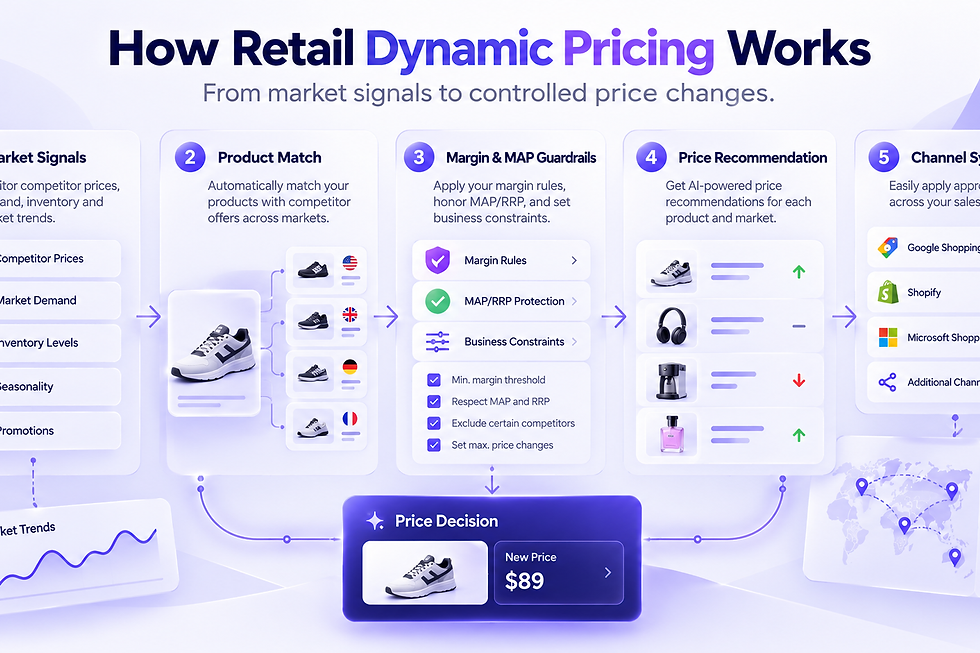
The signals that matter most
Competitor prices and market position.
Accurate product and variant matching.
Gross margin or contribution constraints.
Inventory and sell-through.
Sales, demand and conversion trends.
Seasonality and promotion status.
Market, channel and currency context.
A simple retail pricing optimization workflow
1. Define the objective
Start with the outcome you want to improve. A margin-protection rule, a sell-through objective and a market-share objective can lead to very different recommended prices for the same product.
2. Build the market view
Collect competitor prices, availability and seller context, then confirm that the compared offers represent the same product or a deliberately comparable alternative.
3. Add internal constraints
Combine market position with margin, inventory, demand and any category or brand rules. This is what prevents the pricing workflow from becoming a race to the bottom.
4. Generate a recommendation
A recommendation can be to increase, decrease or hold the current price. The reasoning should be clear enough that a pricing manager can understand which signals drove the action.
5. Apply guardrails and approvals
Use minimum margins, maximum allowed changes, match-confidence requirements and approval thresholds before a price is executed.
6. Measure what happened
Track the result after a price change. Optimization improves when the team can compare the recommendation with later sales, margin, conversion or inventory outcomes.
Retail price optimization vs. dynamic pricing
Retail price optimization focuses on choosing the price that best supports a defined objective. Dynamic pricing is the broader strategy and execution process that allows prices to change as conditions evolve. A retailer can use optimization to generate recommendations and dynamic pricing to execute them under controlled rules.
Retail price optimization vs. pricing analytics
Pricing analytics explains what is happening: market position, margin movement, sales performance and pricing trends. Optimization uses those observations to determine the next action. In practice, the two should work together.
What to look for in retail price optimization software
Reliable competitor and market-price data.
Strong product matching and confidence controls.
Margin, floor-price and maximum-change guardrails.
Inventory, sales or demand inputs.
Explainable pricing recommendations.
Approval and audit workflows.
Multi-market support.
Integration with storefronts, feeds or downstream pricing systems.
Example: when the cheapest price is not the optimal price
Imagine a product that is already cheaper than the main competitors, has healthy sales and limited inventory. A simplistic repricing rule might still lower the price if one seller briefly discounts. An optimization workflow can recognize that the retailer is already competitively positioned and that reducing price would sacrifice margin without solving a real problem.
Where Intelis fits
Intelis combines competitor pricing data, product matching, market context and configurable pricing logic so ecommerce teams can move from monitoring to controlled pricing decisions. The same workflow can support recommendations first and more automated execution as rules mature.
Frequently asked questions
What is retail pricing optimization?
It is the process of using market and business data to improve product prices according to objectives such as margin, competitiveness, revenue or sell-through.
Does price optimization always lower prices?
No. A good optimization workflow can recommend increasing a price, reducing it or leaving it unchanged.
What is the difference between retail pricing optimization and dynamic pricing?
Optimization determines the preferred price or action. Dynamic pricing governs how prices change as signals and conditions evolve.
Put retail price optimization into practice
See how Intelis applies retail pricing optimization to real product catalogs with Price Optimization Software.


